
Geomagnetic storm forecast - 03rd June 2026
What Has Happened?
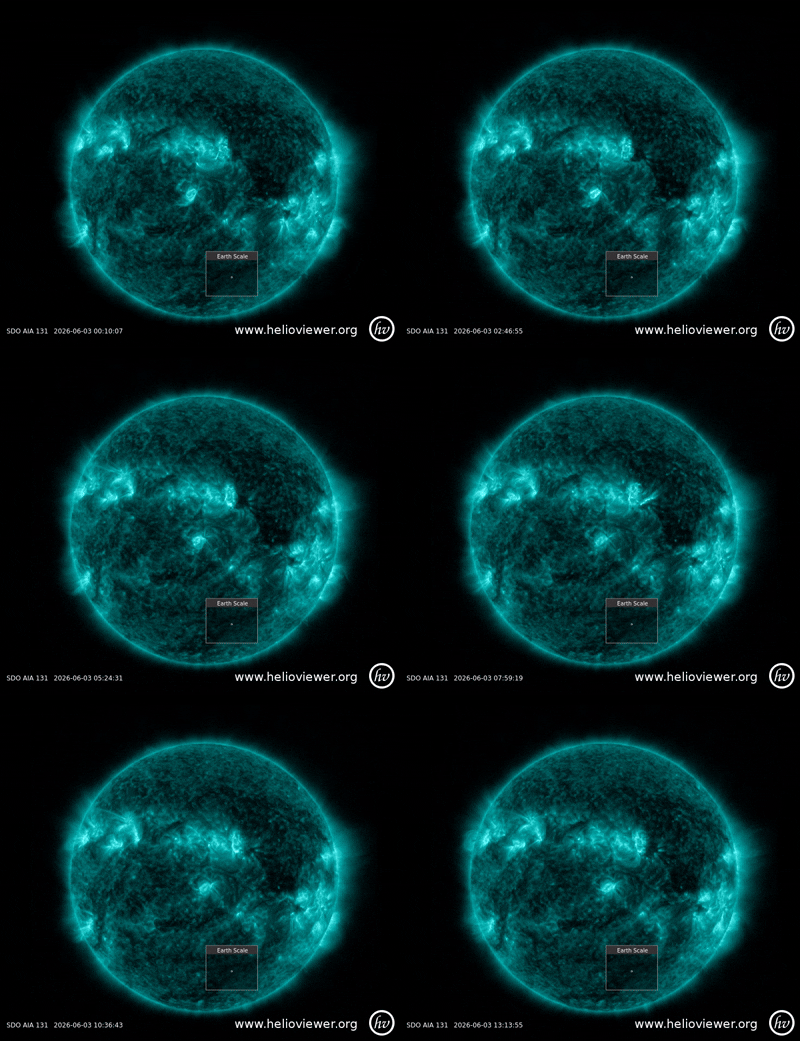
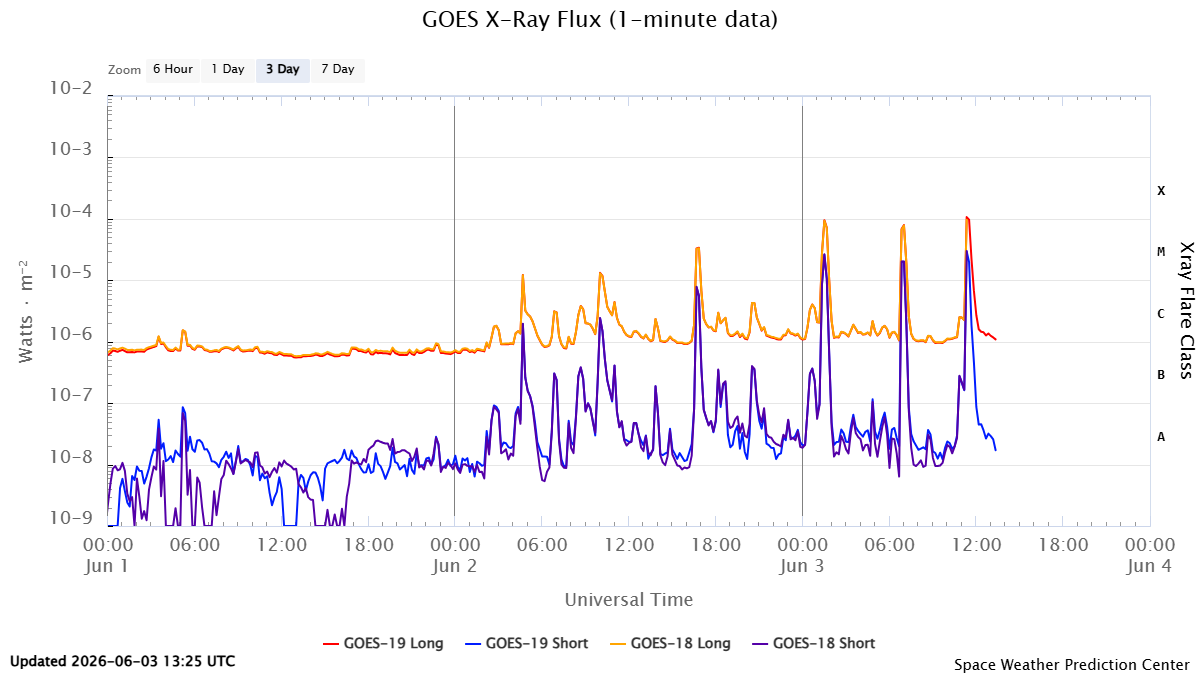
An increase in geomagnetic activity is expected from tomorrow, 4th of June, due to increased solar activity.
A faint halo coronal mass ejection (CME) left the Sun at approximately 01:40 UT on 3rd June. It was associated with an M9 class solar flare originating from an active region close to the centre of the Sun. This same region later produced another CME at 07:58 UT associated with an M7 class flare.
A coronal hole high speed stream is also starting to become geo-effective (3rd June) which means the near-Earth environment will already be disturbed before any CMEs arrive. The initial CME is expected to arrive during the afternoon/evening on the 4th of June and is likely to lead to a significant enhancement in geomagnetic activity, making STORM periods likely. If the second CME combines with the first, geomagnetic conditions could possibly reach STORM G4 levels on the NOAA Geomagnetic storm scales.
An X1 class flare has also recently erupted (11.20 UT) from the same region. Further analysis of this ongoing event is needed to determine its impact. However, early indications suggest there may be another CME with an Earth-directed component, which could bring further geomagnetic activity enhancements.
Assuming clear dark skies, there is an increased chance of seeing the aurora tomorrow night and the following night, 4th and 5th of June. Those in Scotland, northern England and Northern Ireland have the best chance if the weather is favourable. Note however that with the reduced hours of darkness during the northern hemisphere summer, especially further north, the overnight window for aurora viewing is considerably shorter than other times of the year.
Sign-up to receive Geomagnetic Storm Forecast emails.
Follow us on Twitter:
Follow @BGSauroraAlert for more occasional aurora alerts.
Follow @BGSspaceWeather for daily space weather forecasts.
Glossary
- BGS
- The British Geological Survey is a geoscience research centre that is part of UK Research and Innovation (UKRI) and affiliated to the Natural Environment Research Council (NERC).
- CME or Coronal Mass Ejection
- The eruption of a portion of the outer atmosphere of the Sun into space, caused by rapid changes in its magnetic field. Often occurs along with a solar flare.
- Solar Flare
- Energy released by the explosive reorganisation of magnetic fields within the Sun's atmosphere.
- Coronal Hole
- A region in the Sun’s outer atmosphere (corona) where hot material can flow unrestrained by its magnetic fields out into space.
- Sunspot/Active Region
- A region of intense magnetic field in the Sun's visible outer atmosphere often associated with flares and CMEs.