
Geomagnetic storm forecast - 19th January 2026
What Has Happened?

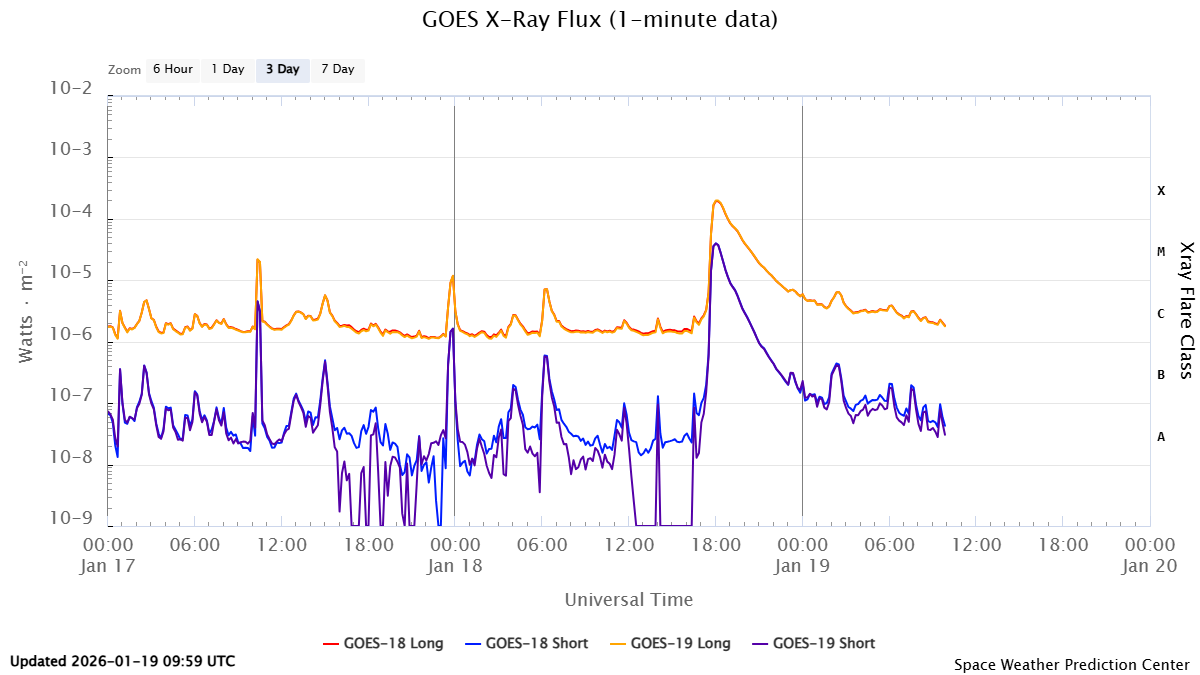
We are expecting an increase in geomagnetic activity during the next 48 hours due to recent strong solar activity.
A full-halo coronal mass ejection (CME) left the Sun at approximately 18:10 UT on 18th January. It was associated with a long-duration X1.9 class solar flare originating from an active region in the south-east quadrant of the Sun.
The CME is expected to arrive late tonight (19th) or in the early hours of tomorrow morning (20th), and is predicted to lead to a significant enhancement in geomagnetic activity, making STORM periods likely.
Assuming clear dark skies, there is an increased chance of seeing the aurora tonight and tomorrow. Those in Scotland, northern England and Northern Ireland have the best chance if the weather is favourable.
Sign-up to receive Geomagnetic Storm Forecast emails.
Follow us on Twitter:
Follow @BGSauroraAlert for more occasional aurora alerts.
Follow @BGSspaceWeather for daily space weather forecasts.
Glossary
- BGS
- The British Geological Survey is a geoscience research centre that is part of UK Research and Innovation (UKRI) and affiliated to the Natural Environment Research Council (NERC).
- CME or Coronal Mass Ejection
- The eruption of a portion of the outer atmosphere of the Sun into space, caused by rapid changes in its magnetic field. Often occurs along with a solar flare.
- Solar Flare
- Energy released by the explosive reorganisation of magnetic fields within the Sun's atmosphere.
- Sunspot/Active Region
- A region of intense magnetic field in the Sun's visible outer atmosphere often associated with flares and CMEs.